Case Study
Pop-Up Coffee Bar: A Modular Build From Concept To Opening Day
Case study: a 28-day timeline from first brief to opening day for a portable kiosk coffee bar — design, permitting, fit-out, equipment install and day-one operations walked through.
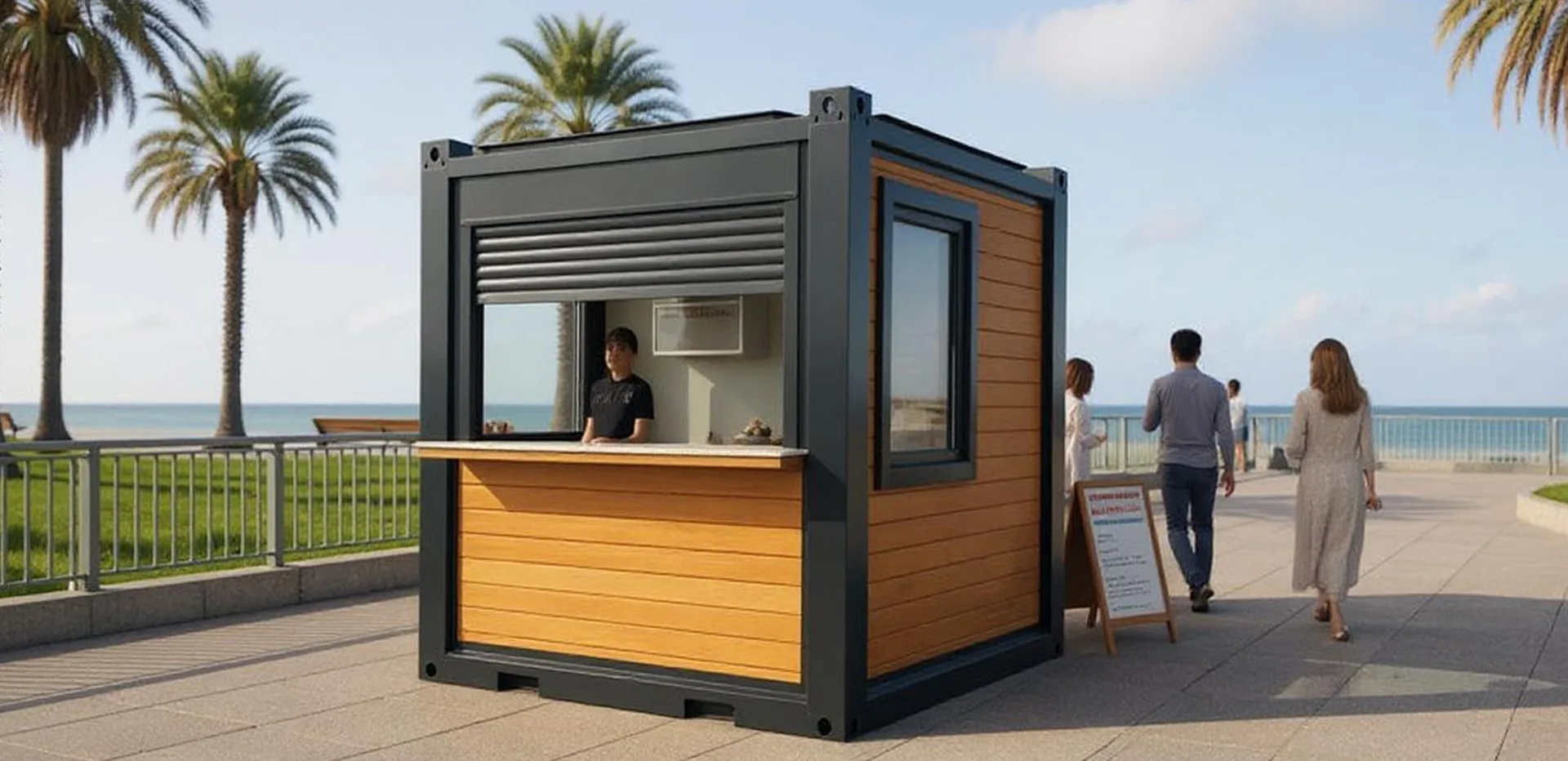
A hospitality operator approached MODDOLIVING with a tight brief: a pop-up specialty coffee bar on a corner pitch in a redeveloping urban district, opening to the public in 28 days. The operator had the lease, the brand identity and the espresso platform — they needed the building.
This case study walks through the four-week timeline from first brief to opening day, with the specification decisions that mattered at each stage. The unit was a MODDOLIVING K600 portable kiosk, branded and fit-out to the operator’s specialty coffee programme.
Week 1 — Design freeze and equipment specification
The brief landed on a Monday. By Friday the design was frozen — five working days from concept to factory release.
Day 1–2 went into mapping the equipment platform: two-group La Marzocco espresso machine, twin grinders, a Mahlkönig EK43 for filter, a slim under-counter ice machine, a refrigerated milk drawer, a small dishwasher and a POS station with handheld order-taking. The list dictated counter depth (700 mm), power load (32-amp single-phase plus dedicated 16-amp circuits for the espresso platform), and plumbing (mains-pressure feed, dedicated drain).
Day 3–4 reviewed cladding and brand application. The operator’s brand book specified a matte charcoal exterior with a brass trim on the serving hatch and oak counter. MODDOLIVING’s spec team confirmed the WPC composite cladding could take the brand colour as a factory-applied finish, and the serving hatch frame could be powder-coated brass.
Day 5 froze the spec, signed the order, deposit cleared, factory release issued. The factory clock started on the following Monday.
Week 2 — Permitting and site prep in parallel
While the factory cut the chassis and welded the frame, the operator’s team handled the permit submission and site prep in parallel.
The pop-up sat in a redeveloping district with a published planning policy that allowed temporary commercial use up to 18 months on a fast-track application — 10 working days for review against 8–12 weeks for a standard application. The MODDOLIVING certification pack (structural calculations, fire performance, MEP load schedule) was bundled with the application on day 1 of Week 2, and approval landed on day 9.
Site prep ran on a tight schedule: an existing concrete pad needed minor levelling, a power supply needed to be brought 8 metres from the building line, and a mains water feed and waste connection needed to be installed by a local plumber. All three were complete by the end of Week 2, in time for the unit’s arrival.
Week 3 — Factory build and brand application
Factory build ran through Week 3 on the standard 6-day production cycle for a custom-branded K600. The galvanised chassis was finished by Tuesday, the wall and roof panels by Thursday, the WPC cladding (in the brand charcoal) installed by Friday, and the brass serving hatch and oak counter installed over the weekend.
The operator’s team came to the factory on Saturday for a pre-shipment walkthrough — a standard step on custom-branded hospitality builds. They confirmed the brand application, signed off the equipment cut-outs and approved the unit for despatch on Monday of Week 4.
Week 4 — Delivery, equipment install and soft launch
The unit arrived on site on Monday morning of Week 4. Crane offload took 45 minutes; levelling and chassis-to-base bolting took another 30. Power, water and waste were connected in the afternoon by the operator’s local trades. The unit was weather-tight and powered by 4 PM on day 1.
Day 2 was equipment install: La Marzocco engineers commissioned the espresso platform, the grinders were calibrated, the milk drawer plumbed in, the POS station connected to the operator’s existing back-of-house system. The whole equipment fit-out took 6 hours.
Day 3 was a soft launch — staff training, opening-day workflow rehearsals, a friends-and-family invite for the first 50 covers. Two minor snags surfaced (one cabinet hinge that needed re-aligning, one drain trap that needed a longer extension) and were both fixed by end of day.
Day 4 — opening day — the unit served its first paid drinks at 7 AM.
What made the 28-day timeline work
Three things made the timeline possible. First, an early specification freeze (end of Week 1) — every day the spec drifts is a day the factory cannot start. Second, parallel permitting and site prep — Week 2 was simultaneous factory work and operator-side prep, not sequential. Third, a pre-shipment factory walkthrough — catching brand-application issues on Saturday at the factory is cheaper than catching them on Monday on site.
For operators looking at a similar timeline, the brief that lands first wins the production slot. Share the use case, brand context and target opening date — we respond within one working day with a feasibility note and a four-week production calendar if it works.