Specification Guide
Security Hut Specification: Compliance, Comfort & Cost
Specification guide for insulated security huts and guard cabins — UK HSE welfare rules, US OSHA requirements, HVAC sizing, anti-vandal cladding and observation glazing for 24/7 deployment.
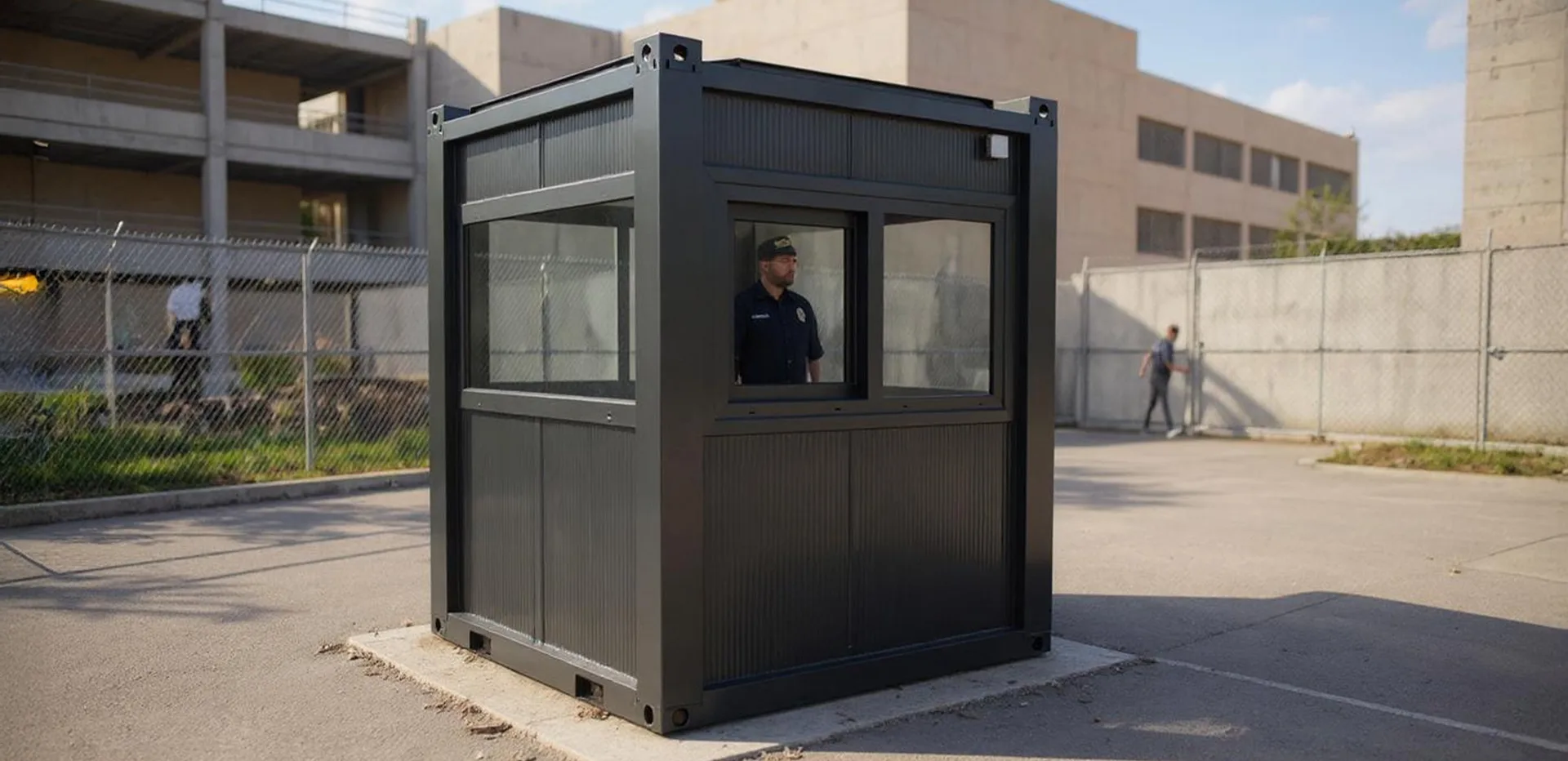
A security hut is one of the easier modular categories to under-specify. The unit looks small, the brief looks simple, the budget often gets compressed late in the project — and the consequences land months later, when the guard inside is too cold in winter, too hot in summer, or working in a cabin that doesn’t meet welfare regulations for 24/7 occupation.
This guide walks through the three areas where security hut specs most often go wrong: compliance, climate control and anti-vandal hardening. If you specify these three correctly at brief stage, the rest of the order is essentially catalogue.
Compliance: welfare rules for occupied cabins
A security hut is a workplace. That matters in the UK, the US and the EU because once a person is occupying the cabin for more than a single shift, welfare regulations apply — and they apply to the cabin you provide, not just the wider site.
In the United Kingdom, the Health and Safety Executive (HSE) Approved Code of Practice L24 sets out the welfare requirements for a workplace cabin: adequate space (5 m² minimum for a single occupant), thermal comfort (target 16°C minimum for sedentary work), ventilation, lighting and access to washing facilities. A security hut on a construction site is typically paired with a separate sanitary cabin to meet the washing requirement; a standalone urban guard post needs a wash facility within reasonable distance.
In the United States, OSHA 29 CFR 1910 sets analogous requirements: minimum cubic feet per occupant, mechanical ventilation, lighting levels and access to drinking water and sanitary facilities. State-level amendments often add temperature standards (e.g., California IIPP) for prolonged outdoor or marginally-enclosed work.
In the European Union, the Workplace Directive 89/654/EEC sets the framework; member states implement with national thresholds.
The takeaway: specify the cabin for the welfare-compliant case, not the minimum-cost case. The cost delta between a compliant and non-compliant cabin is small at brief stage and large at retrofit stage.
Climate control: sizing the HVAC for 24/7
A security hut runs around the clock. Sizing the HVAC for the worst-day case — the coldest winter morning, the hottest summer afternoon — matters more than for an office or a retail cabin that operates within business hours.
The simple rule for the MODDOLIVING range:
- T110G (0.99 m² interior, single-person gate post) — 0.5 kW oil-filled radiant heater + roof vent. No cooling required in temperate climates; add a small split unit for hot-climate deployment.
- T135G (2.18 m² interior, single-person guard cabin) — 1.0 kW convector heater + extractor vent. Optional 1.5 kW reverse-cycle split for cooling.
- T200G (3.40 m² interior, two-person observation cabin) — 1.5 kW convector or low-output reverse-cycle split unit (heating + cooling combined). Mechanical ventilation rate matched to two-person occupancy.
The continuous insulation envelope on every MODDOLIVING security hut — 50 mm wall, 75 mm roof, U-value around 0.30 W/m²K — keeps these heating loads modest. A poorly insulated guard cabin can need 2–3× the heating load for the same internal target.
Anti-vandal hardening: where 24/7 hardware pays back
A security hut spends its life in environments where it may be subject to attempted forced entry, vandalism or accidental impact. Anti-vandal hardening is the small set of spec choices that mean the cabin survives those incidents without write-off.
The four hardening choices that matter:
- Cladding material — steel or composite, both rated for impact. Avoid timber cladding on perimeter security applications.
- Observation glazing — laminated safety glass or polycarbonate, not standard double-glazed units. Laminated glass holds together after impact; polycarbonate flexes under impact without shattering.
- Door hardware — multi-point locking on a steel-framed door with reinforced hinges. The factory-fit option on every MODDOLIVING security hut includes a 5-point locking system as standard.
- Penetration sealing — every cable, pipe and vent run that enters the cabin envelope is a potential entry point. Specify factory-sealed penetrations with anti-tamper covers on perimeter applications.
The cost delta for all four hardening choices, applied together, is around 8–12% of the base cabin price. The cost of one successful break-in (cabin damage, replacement, downtime, insurance excess) typically exceeds that delta on its own.
What to bring to the brief
Security hut briefs benefit from three specific inputs: site context (perimeter security, gate-house, parking attendant, construction-site post), occupancy pattern (single shift, double shift, 24/7), and climate zone (target heating and cooling design temperatures).
With those three inputs, the MODDOLIVING specification team can match the catalogue model, recommend the welfare-compliant fit-out, size the HVAC correctly and apply the right hardening package — all inside the standard 6–8 week production lead time for the security hut range.